Does your dog love fetch? Swimming? Hiking? Playing with other dogs? Is there anything better than watching your dog having fun? It’s great to know what your dog loves to do but did you know that IF there is only one or two main sources of exercise that it can actually work against you?

Many dog owners have one focus in their dog’s daily exercise – whatever is going to tire out their dog physically… the fastest or with the least amount of effort. For example, taking their dog to the dog park or daycare everyday or playing fetch until their dog collapses.

The thing is, if your dog’s main source of exercise is highly arousing with little mental engagement; then you are creating a dog who seeks adrenaline inducing fun. Why is this problematic? This creates a dog who does not practice impulse control and is easily frustrated, which is the gateway to problematic behaviors at home such as:
- demand barking
- a dog who “cannot” settle
- destructive chewing
- barrier frustration such as barking uncontrollably in the window, at the door, fence fighting with the neighbor’s dog
- Not being reliable off leash
- uncontrollable jumping out of excitement
- and more
These are the dogs who are already over threshold by the time they leave the house for their daily exercise 🦮 and exhibiting excessive leash pulling and/or leash reactivity. You want your dog’s daily exercise to work for you.
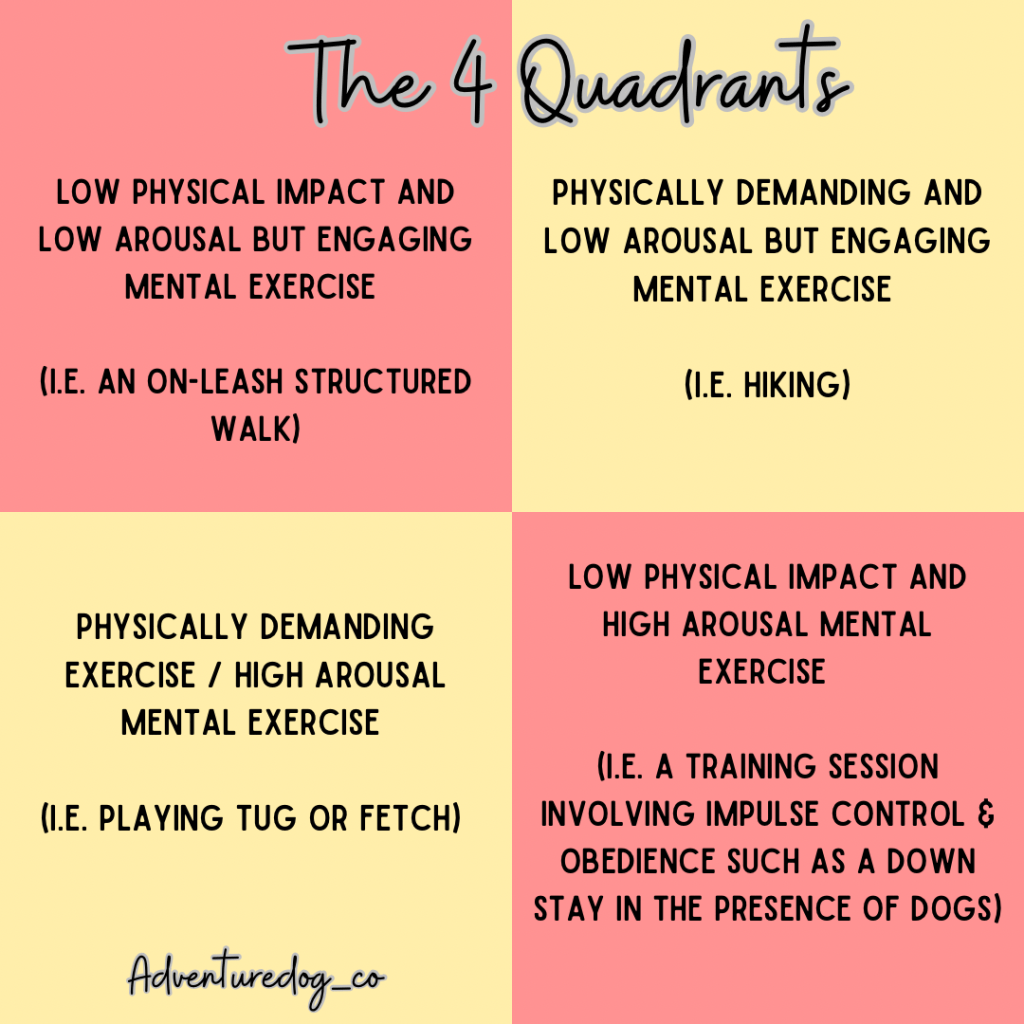
We believe in utilizing four quadrants to achieve balanced exercise for any dog. How you exercise your dog and how much or little variation you use – directly affects your dog’s behavior in other aspects of life.
Balance is what every dog NEEDS. If your dog loves highly arousing exercise, that’s awesome but it is very important to keep your dog mentally balanced by also implementing low arousal exercise. 👉🏻If your dog is a lower energy dog, they may not show interest in things like fetch or tug but it is also equally important to teach that dog how to engage in higher stimulating exercises – whatever that may be.
Utilizing these quadrants will look different for every dog and owner, but providing your dog a variety of exercise each week is KEY. All dogs need different mental and physical exercise outlets to ensure their daily needs are met and that their biological needs are fulfilled.

If you have any behaviors that you are struggling with at home or in public – take a look at the daily exercise you are currently providing or NOT providing because that is affecting your dog’s behavior for better or for worse. How you exercise your dog and what behaviors you allow during exercise – matters.
The 4 Quadrants are:
- Low physical impact / Low arousal but engaging mental exercise (I.e. an on-leash structured walk)
- Physically demanding / Low arousal but engaging mental exercise (I.e. hiking)
- Low physical impact / High arousal mental exercise (I.e. a training session involving impulse control & obedience such as a down stay in the presence of dogs)
- Physically demanding exercise / High arousal mental exercise (I.e. playing tug or fetch)
 Training Adventure Dogs
Leave a comment